
GUE Fundamentals
Course Outcomes
The GUE Fundamentals course is designed to cultivate the essential skills required by all sound diving practice. Included among its course outcomes are: to provide the recreational diver, who does not desire further diver training, with an opportunity to advance his/her basic diving skills; to train divers in the theory and practice of Nitrox; to provide divers with aspirations for more advanced diver training with the tools that will contribute to a greater likelihood of success; and to provide non-GUE trained divers with a gateway into GUE training.
Prerequisites
Applicants for a Fundamentals course must:
- Submit a completed registration form, a medical history, and a liability release to GUE Headquarters.
- Be physically and mentally fit.
- Hold insurance that will cover diving emergencies such as hyperbaric treatment, e.g. DAN Master-level insurance or equivalent.
- Be a nonsmoker.
- Obtain a physician’s prior written authorization for the use of prescription drugs, except for birth control, or for any prior medical condition that may pose a risk while diving.
- Be a minimum of 16 years of age.
- Be a certified GUE Rec 1 diver or be certified as an open water diver from a recognized training agency.
Course Content
The Fundamentals course is normally conducted over four days, requires 6 dives and at least 30 hours instruction, encompassing classroom, land drills and in-water work.
GUE Fundamentals Specific Training Standards
- Student-to-instructor ratio is not to exceed 8:1 during land drill or surface exercises; it cannot exceed 4:1 during any in-water training.
- Critical skills may only be performed up to a maximum depth of 30 feet/9 meters
- Two dives must be at a depth of at least 25 feet/8 meters
- Maximum depth 60 feet/18 meters
- No overhead diving
- No decompression
- Required Training Materials
GUE training materials and recommended reading as determined by the course study packet received via online download after GUE course registration.
Academic Topics
- Introduction: GUE organization and course overview (objectives, limits, expectations)
- Building a solid skill base - buoyancy, trim, balance and propulsion
- Fundamental diving skills
- Streamlining and equipment configuration
- Situational awareness
- Dive planning and gas management
- Breathing gas overview
- Nitrox
- Decompression overview and minimum decompression procedures
- Diving safety and accident prevention
- The GUE system
Land Drills and Topics
- Dive team protocols
- Basic Five
- S-drill and valve-drill
- Equipment fit and functions
- Propulsion techniques
- Pre-dive drills
- Surface marker deployment
- Diver rescue techniques (Fundamentals Tech)
Required Dive Skills and Drills for Fundamentals Rating
(A) Required Dive Skills and Drills for a Fundamentals-Recreational Rating
- Must be able to swim at least 300 yards/275 meters in less than 14 minutes without stopping. This test should be conducted in a swimsuit and, where necessary, appropriate thermal protection.
- Must be able to swim a distance of at least 50 feet/15 meters on a breath hold while submerged.
- Demonstrate proficiency in safe diving practices; this would include pre-dive preparation, in-water activity, and post-dive assessment.
- Demonstrate awareness of team member location and a concern for safety, responding quickly to visual indications and dive partner requirements.
- Demonstrate good buoyancy and trim, i.e. approximate reference is a maximum of 30 degrees off horizontal while remaining within 5 feet/1.5 meters of a target depth.
- Demonstrate proficiency in lift bag/surface marker buoy deployment while using a spool.
- Efficiently and comfortably demonstrate how to donate gas to an out-of-gas diver in multiple gas-sharing scenarios.
- Efficiently and comfortably demonstrate how to donate gas to an out-of-gas diver followed by an ascent to the surface, utilizing minimum decompression.
- Demonstrate a safe and responsible demeanor throughout all training.
- Demonstrate proficiency in underwater communication.
- Demonstrate a comfortable demeanor while swimming without a mask, in touch contact.
- Demonstrate aptitude in the following open water skills: mask clearing, mask removal and replacement, regulator removal and exchange, long-hose deployment.
- Demonstrate safe ascent and descent procedures.
- Demonstrate proficiency in executing a valve drill.
- Demonstrate basic equipment proficiency and an understanding of the GUE equipment configuration.
- Demonstrate three propulsion techniques. Students should demonstrate comprehension of the components necessary for a successful backward kick.
(B) Required Dive Skills and Drills for a Fundamentals-Technical Rating
This rating is required for those trainees seeking entry into GUE’s Cave and Technical courses. Skills 14-19 must be graded as a 3 or higher.
- Must be able to swim at least 300 yards/275 meters in less than 14 minutes without stopping. This test should be conducted in a swimsuit and, where necessary, appropriate thermal protection.
- Must be able to swim a distance of at least 50 feet/15 meters on a breath hold while submerged.
- Demonstrate proficiency in safe diving practices; this would include pre-dive preparation, in-water activity, and post-dive assessment.
- Demonstrate awareness of team member location and a concern for safety, responding quickly to visual indications and dive partner requirements.
- Demonstrate good buoyancy and trim, i.e. approximate reference is a maximum of 20 degrees off horizontal while remaining within 3 feet/1 meter of a target depth.
- Demonstrate proficiency in the ability to deploy a surface marker buoy while using a spool.
- Efficiently and comfortably demonstrate how to donate gas to an out-of-gas diver in multiple gas-sharing episodes.
- Efficiently and comfortably demonstrate how to donate gas to an out-of-gas diver followed by an ascent to the surface, utilizing minimum decompression.
- Demonstrate a safe and responsible demeanor throughout all training.
- Demonstrate proficiency in underwater communication.
- Demonstrate a comfortable demeanor while swimming without a mask, in touch contact.
- Demonstrate aptitude in the following open water skills: mask clearing, mask removal and replacement, regulator removal and exchange, long-hose deployment.
- Demonstrate safe ascent and descent procedures.
- Demonstrate an efficient valve drill with double tanks.
- Demonstrate basic equipment proficiency and an understanding of the GUE equipment configuration.
- Demonstrate proficiency in four propulsion techniques that would be appropriate in delicate and/or silty environments; students should also demonstrate competence in the backward kick and helicopter turns.
- Demonstrate proficiency with a primary light by using it during all skills except SMB deployment.
- Demonstrate diver rescue techniques, including effective management of an unconscious diver underwater.
Equipment Requirements
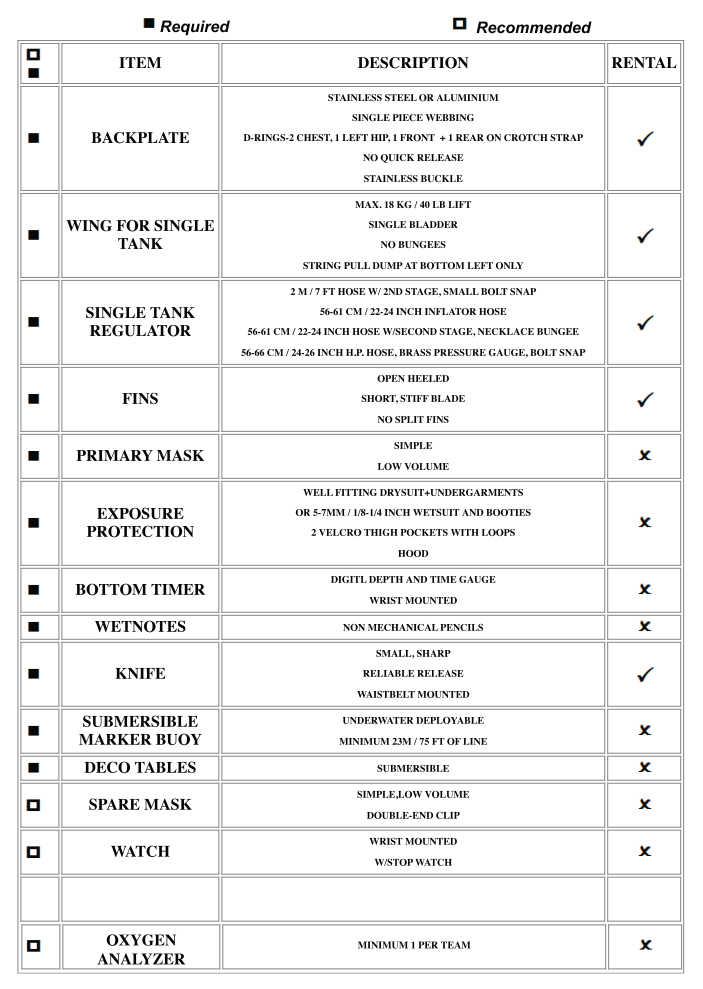
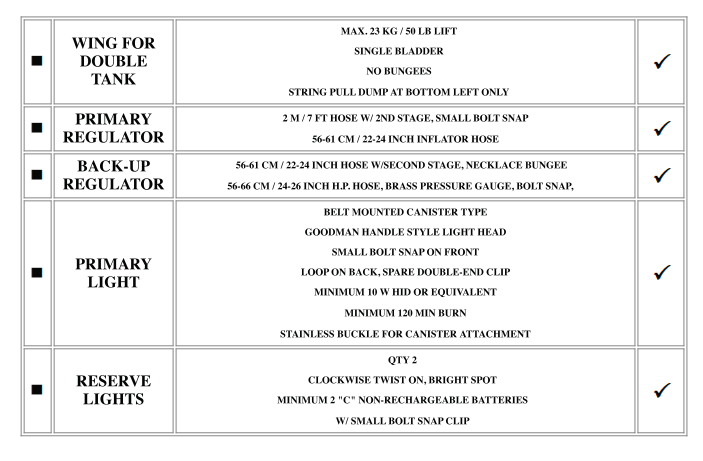
(A) Required Equipment for a Fundamentals-Recreational Rating
GUE base configuration as outlined in Appendix A.
(B) Required Equipment for a Fundamentals-Technical Rating
GUE base Configuration as outlined in Appendix A, plus:
- GUE double tank configuration
- Primary and back-up lights
- Back-up mask
Note: Prior to the commencement of class, students should consult with a GUE representative to verify equipment requirements. Whether or not a piece of equipment fulfills GUE’s equipment requirement remains at the discretion of GUE and its instructor representatives. Participants are responsible for providing all equipment or for making provisions to secure the use of necessary equipment before the start of the course. In general, it is better for the student to learn while using his or her own equipment. However, students should exercise caution before purchasing new equipment to avoid acquiring substandard equipment. Please contact a GUE representative prior to making any purchases. Information about recommended equipment can be obtained from the equipment considerations section of GUE's Web site.
Please contact us for further information about joining our next GUE Fundamentals Course.
DIR México/ Pto. Aventuras
Quintana Roo, México 77733
Copyright©2001 - 2019 - All rights reserved